
|
|
|

APPLICATIONS
When light (radiometric energy) is projected on to a physical object, it is vibration and stretching of chemical bonds, both on the surface and inside objects. Different objects will vibrate and stretch in unique ways - explaining why objects "look different" to the human eye. But human eyes can't accurately distinguish subtle differences in color (reflectance of objects) - but advanced cameras can!

—
APPLICATIONS — INTRODUCTION
Fig. 1: Hyperspectral imaging data is acquired under highly controlled lighting on a conveyor belt.
Now, in the image of melon seeds - one is hollow (no germ), while the other seeds have fully developed germ. Only highly trained people can distinguish seeds with/without fully developed germ, and the process is time-consuming. But high-resolution spectral data (reflectance profiles) show clear differences, so that specific "spectral features" can be used to in machine learning algorithms to classify melon seeds quickly, accurately, and non-destructively. Furthermore, the classification and sorting process can be automated.
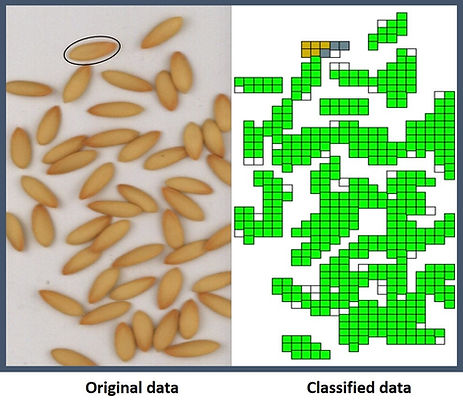
Fig. 2: Sample Melon Seed Analysis
"Hyperspectral imaging" implies that we use imaging sensors that collect reflectance data in hundreds of narrow spectral bands across a wide range of wavelengths. For comparison, a normal camera has only three wide spectral bands (RGB - the visible spectrum dividied into three ranges, red, green, and blue), so each pixel only has three reflectance values. The high spectral resolution of hyperspectral imaging
data enables Spectral Analytix to develop optical solutions with very high accuracy - even when objects are indistinguishable by the human eye.
Spectral Analytix Inc. is specializing in use of optical sensing technology to provide customized sorting and classification solutions of crop seeds and insects.

APPLICATIONS — INSECT "STRESS"
—
We are all familiar with the idea that a thermometer can be used to measure our body temperature, and that a high body temperature, fever, is indicative of us being ill. Well, that is precisely what we are doing! But instead of using a thermometer (which uses thermal reflectance data), we are collecting and analyzing high-spatial resolution data across a wide range of wavelengths.
Suppose now, that we have two groups of mosquitoes, and that we acquire high-spatial resolution imaging reflectance data from both groups of mosquitoes at multiple time points - we develop a time series

data set. One of these groups of insects is "control", while the other group of insects have been exposed to some experimental level stress (for instance, treated with an insecticide). We would expect "reflectance features" (specific traits within the high-spatial resolution imaging reflectance data) to be similar between the two groups, until the effect of the stressors "kicks in" - as indicated by the arrow.

Spectral Analytix Inc can detect and quantify responses by individual insects and other living organisms to stressors over time. This information can be used either alone or in combination with behavioral data or molecular data explain and describe treatment effects.
Published example from 2016: Detection of Temporal Changes in Insect Body Reflectance in Response to Killing Agents
Fig. 3: Insect "Stress" Data
TECHNOLOGY — INSECT IDENTIFICATION
—
Insects being a threat to humans, livestock and to crop plants
Mosquitoes are known to carry and infect humans with some of the most important global diseases, such as, malaria and west Nile virus. Other insects transmit diseases to livestock and crop plants. With these vector threats, we worry about the disease, not the insect per se, and, in development of effective disease management programs, it is very important to have technologies and methods to differentiate between insect individuals of the same species with/without the disease.
Programs to control insect vectors are often expensive, require coordination of complex logistics, and they can have unintended negative effects on the environment. So they should only be implemented WHEN and WHERE they are needed. To determine WHEN and WHERE, it is important to have reliable data describing insect population changes over time and space and also about the percentage of insects carrying the disease.

Fig. 4: Ratio of Healthy : Sick Insects
Spectral Analytix Inc uses high-resolution spectral data from body reflectance profiles of individual insects to determine whether they carry diseases or not. This information can be used by individual farmers to determine when and where insect management should be implemented. It can also b used by organizations, agencies, and researchers either alone or in combination with weather data, land cover data etc to develop risk models and to coordinate region-wide management practices.

TECHNOLOGY — CROP SEED VIABILITY
—
Rapid and consistent viability testing of tomato seeds
Viability testing is one of the most important and frequent quality control procedures. And seed viability can only decline - once a seed is dead, then it needs to be excluded. Time of storage, storage conditions, and seed handling/processing are all factors causing loss of seed viability. Selling samples with low viability causes rejects, and they are a hassle for everybody involved...
Traditional viability testing of seeds takes 10-14 days, and results are often quite variable. Spectral Analytix Inc. can provide test results with higher and more consistent accuracy, no handling/processing of seeds is necessary, and results are obtained in 48-72 hours.
—

Fig. 5: Tomato Seeds
Proof of Concept
A client provided five samples of tomato seeds - all with know percentages of viable seeds ranging from %. Optical data from the two seed samples with highest and lowest viabilities were used as "training data" to develop an algorithm that can separate viable and non-viable seeds. Afterwards, optical data were collected from all five seed samples, and it is seen that predicted and actual viabilities were very similar - even for the three samples not included in the training data.

Fig. 6: Tomato Seed Sample Data
We have identified unique spectral features associated with viable and non-viable seeds, and we can use those spectral features to develop high accurate and fast sorting and classification solutions. Customized viability solutions can also be developed for other crop seeds.
TECHNOLOGY — CROP SEED OPPORTUNITIES
—
Quality control and discovery
Ploidy, sex (male, female, and hermaphrodite), germ size - these are just some of the many "traits" in seeds that are important in both breeding and commercial operations. How to eliminate or select only a few seeds, which represent a small fraction of all seeds in a sample? How to maximize the uniformity of seed samples? And how to perform such quality control and breeding discovery non-destructively (without loosing/damaging seeds) and in a time-efficient manner?
Spectral Analytix Inc can offer you unsurpassed quality in terms of optical technology and customer support.